
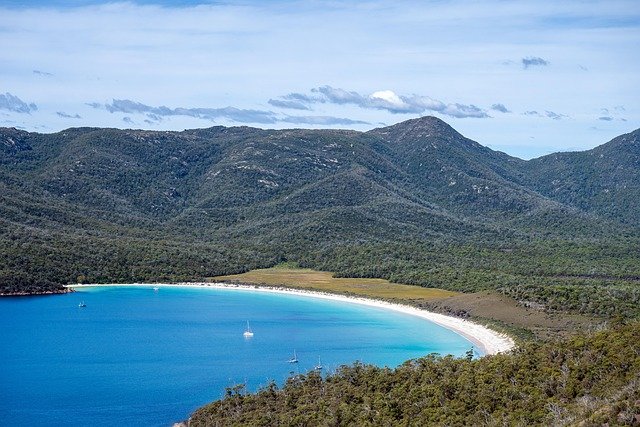
Freycinet National Park brings together some of the landscapes most closely associated with Tasmania’s East Coast: granite mountains, sheltered turquoise bays, long beaches, coastal heath and walking tracks that climb towards broad views across the Freycinet Peninsula.
Wineglass Bay is the park’s best-known attraction, but Freycinet is much larger and more varied than the famous view from the Wineglass Bay Lookout. Visitors can walk beneath the Hazards, descend to Wineglass Bay Beach, explore Honeymoon Bay and Sleepy Bay, follow the easy Cape Tourville circuit, spend time on Friendly Beaches, kayak around the coastline or undertake longer walks across the peninsula.
The nearby coastal village of Coles Bay provides the main gateway to the park and makes it possible to spend several days exploring Freycinet without treating the national park as a rushed stop between Hobart and Launceston.
This Freycinet National Park Tasmania guide is designed to help you plan the visit realistically. It covers the major attractions, walks, beaches, park access, accommodation areas, camping, wildlife, weather, safety, suggested itineraries and practical information that can help you decide how much time you actually need.
Freycinet also forms part of a much larger coastal journey. If you are travelling beyond the peninsula, use our East Coast Tasmania Travel Guide to connect Freycinet with Swansea, Bicheno, St Helens and the Bay of Fires. For island-wide planning, begin with our Travel Tasmania guide.
Jump to Freycinet National Park
- Freycinet National Park Overview
- Where Is Freycinet National Park?
- Getting to Freycinet National Park
- Why Visit Freycinet?
- Coles Bay
- Wineglass Bay
- Wineglass Bay Lookout
- Wineglass Bay Beach
- Wineglass Bay & Hazards Beach Circuit
- Mount Amos
- Cape Tourville
- Honeymoon Bay
- Sleepy Bay
- Friendly Beaches
- Best Walks in Freycinet
- Freycinet Peninsula Circuit
- Beaches in Freycinet
- Wildlife
- Kayaking, Boating & Water Activities
- Photography
- Freycinet Parks Pass
- Visitor Centre & Facilities
- Camping
- Where to Stay
- Best Time to Visit
- How Long to Spend in Freycinet
- Freycinet Itineraries
- Walking & Visitor Safety
- Responsible Travel
- Practical Planning Tips
- Frequently Asked Questions
Freycinet National Park Overview
Freycinet National Park protects a substantial part of the Freycinet Peninsula on Tasmania’s East Coast. The landscape is defined by the meeting of granite mountains and the sea: the Hazards rise immediately behind sheltered western bays, while the eastern side of the peninsula faces the more open Tasman Sea.
This geography gives the park much of its variety. A single day can include mountain views, woodland, granite slabs, a sheltered cove, an exposed coastline and a long white beach.
Wineglass Bay is understandably the best-known part of Freycinet. Its curved beach and surrounding granite peaks have become one of Tasmania’s most recognisable natural images. However, visitors who only walk to the lookout and immediately leave experience a relatively small part of the national park.
Cape Tourville provides a much easier coastal walk. Sleepy Bay reveals a rocky eastern shoreline. Honeymoon Bay sits on the sheltered western side. Friendly Beaches forms a separate northern section of the national park, while longer routes lead towards Hazards Beach and deeper into the Freycinet Peninsula.
That variety makes Freycinet suitable for several different kinds of visitor. A traveller who wants a short scenic stop can choose Cape Tourville and Honeymoon Bay. Someone comfortable with a sustained climb can walk to Wineglass Bay Lookout. More experienced walkers can continue to the beach, complete the Hazards Beach circuit, climb Mount Amos in suitable conditions or plan an overnight journey around the peninsula.
Freycinet is therefore better treated as a destination in its own right rather than simply another attraction on an East Coast checklist.
Where Is Freycinet National Park?
Freycinet National Park is on the central section of Tasmania’s East Coast beside Coles Bay.
The peninsula projects into the Tasman Sea and sits across Great Oyster Bay from the coastline around Swansea. This position explains why the Hazards and Freycinet Peninsula can often be seen from the western side of Great Oyster Bay long before travellers reach Coles Bay itself.
According to Tasmania Parks and Wildlife Service, Freycinet National Park is roughly 2.5 to 3 hours by road from either Hobart or Launceston under normal travel conditions. Actual journey times depend on traffic, road conditions, weather and how often you stop.
Travellers following the East Coast usually approach via the Tasman Highway before turning onto Coles Bay Road. The main park entrance and visitor centre are reached by continuing through Coles Bay.
The Friendly Beaches section is separate from the main visitor area and has its own access from Coles Bay Road. It should therefore be considered a separate stop rather than something you automatically pass while driving between the visitor centre and Wineglass Bay.
For broader geographical context, see our East Coast Tasmania Travel Guide.
Getting to Freycinet National Park
Most independent visitors reach Freycinet by car, campervan or organised tour.
A vehicle provides the greatest flexibility because the attractions are spread between Coles Bay, the main national park area, Cape Tourville and the separate Friendly Beaches section.
Hobart to Freycinet National Park
From Hobart, the natural touring route follows Tasmania’s south-east towards Orford and Triabunna before continuing through the East Coast towards Swansea and the Freycinet turn-off.
Tasmania Parks and Wildlife Service gives a general travel estimate of approximately 2.5 to 3 hours between Hobart and the park.
For holiday planning, however, treating that estimate as the entire day’s schedule would miss much of the route. Orford, Triabunna, Great Oyster Bay and Swansea can all justify stops.
If your Tasmania itinerary includes several regions, Freycinet works particularly well as the next major destination after South Tasmania.
Launceston to Freycinet National Park
Freycinet can also be reached from Launceston, with Tasmania Parks and Wildlife Service again advising a broad driving time of roughly 2.5 to 3 hours to the park.
Travellers undertaking a wider East Coast road trip may prefer to connect Launceston with St Helens and the Bay of Fires before moving south through Bicheno towards Freycinet.
This creates a natural north-to-south journey and avoids repeatedly crossing the island.
Freycinet as Part of a Hobart-to-Launceston Road Trip
One of the most efficient ways to include Freycinet is to travel between Hobart and Launceston via the East Coast rather than visiting the peninsula as a return day trip.
A simple route can follow:
Hobart → Orford / Triabunna → Swansea → Freycinet → Bicheno → St Helens → Bay of Fires → Launceston.
The direction can easily be reversed.
If you are still deciding how Freycinet fits into your overall holiday, our Tasmania trip planning guide explains how to choose regions and build a realistic route.
Flying Into Tasmania
For a Freycinet-focused trip, both Hobart and Launceston can work as arrival points.
Hobart may be more convenient when your itinerary also includes southern Tasmania, while Launceston may make more sense when you intend to combine Freycinet with northern Tasmania and the Bay of Fires.
If flights are not yet fixed, you can compare flights to Tasmania before deciding whether Hobart or Launceston produces the better overall route.
Hiring a Car
A standard road vehicle is sufficient for the principal access route to Coles Bay and the main national park entrance.
Some secondary access roads elsewhere in the region can be unsealed. If you are using a rental vehicle, check the provider’s conditions before travelling on unsealed roads rather than assuming every road shown on a map is permitted.
You can compare Tasmania car rental options once you know your arrival airport and whether you plan to return the vehicle in the same city.
Why Visit Freycinet National Park?
Freycinet’s strongest appeal is the concentration of very different coastal landscapes within one national park.
The Hazards create a mountain environment immediately beside the sea. Wineglass Bay provides the famous white arc of beach. Cape Tourville looks towards an exposed ocean coastline. Honeymoon Bay feels comparatively sheltered. Friendly Beaches stretches along a much more open section of the Tasman Sea.
This means visitors do not need to undertake the hardest walks to appreciate the park.
- For first-time visitors: Wineglass Bay Lookout provides the classic Freycinet view.
- For an easy walk: Cape Tourville provides a short Grade 1 circuit.
- For beaches: Wineglass Bay, Friendly Beaches and the smaller bays around the peninsula offer very different settings.
- For experienced walkers: Mount Amos and longer peninsula routes provide more demanding options.
- For families: shorter coastal walks and bays can be combined without committing to an all-day hike.
- For photographers: granite, changing light, mountains and water create very different scenes throughout the day.
- For slower travellers: Coles Bay provides a practical base for spreading the park across several days.
The important point is that there is no single correct way to experience Freycinet.
For some visitors, the ideal day is Wineglass Bay Lookout followed by a quiet afternoon beside Honeymoon Bay. Others may prefer a longer circuit, kayaking or several days exploring the peninsula.
Coles Bay: The Gateway to Freycinet
Coles Bay is the small coastal settlement immediately beside Freycinet National Park and the most practical base for visitors who want easy access to the main park area.
The Hazards rise dramatically behind the township, while Great Oyster Bay opens to the west. This gives Coles Bay a setting that feels closely integrated with the national park rather than separated from it.
Accommodation, food, tours and other visitor services are available in and around the area, although availability varies by season.
Why Stay in Coles Bay?
The greatest advantage is time.
Staying locally means you do not need to begin a major walking day with a long drive from another East Coast town. It also provides greater flexibility if weather makes a planned mountain walk unsuitable.
For example, if low cloud or rain makes Mount Amos a poor choice, staying nearby allows you to switch to Cape Tourville, a beach visit or another shorter activity rather than losing most of the day to driving.
Coles Bay or Swansea?
Coles Bay is generally the better choice when Freycinet itself is the priority.
Swansea, farther south around Great Oyster Bay, can suit travellers who prefer a quieter coastal-town base and do not mind driving farther to reach the national park.
Neither is universally better. The choice depends on what you intend to do the following morning.
Coles Bay or Bicheno?
Bicheno is farther north and has its own beaches, rocky coastline and wildlife experiences.
For a trip centred almost entirely on Freycinet, Coles Bay is more convenient. For a broader East Coast itinerary, Bicheno can work as a useful second base after spending time around the peninsula.
If you have already chosen your dates, you can compare accommodation around Freycinet and Coles Bay. During busy periods, booking the important Freycinet nights before finalising every smaller road-trip stop can make planning easier.
Wineglass Bay
Wineglass Bay is Freycinet National Park’s best-known landscape and one of Tasmania’s most recognisable coastal scenes.
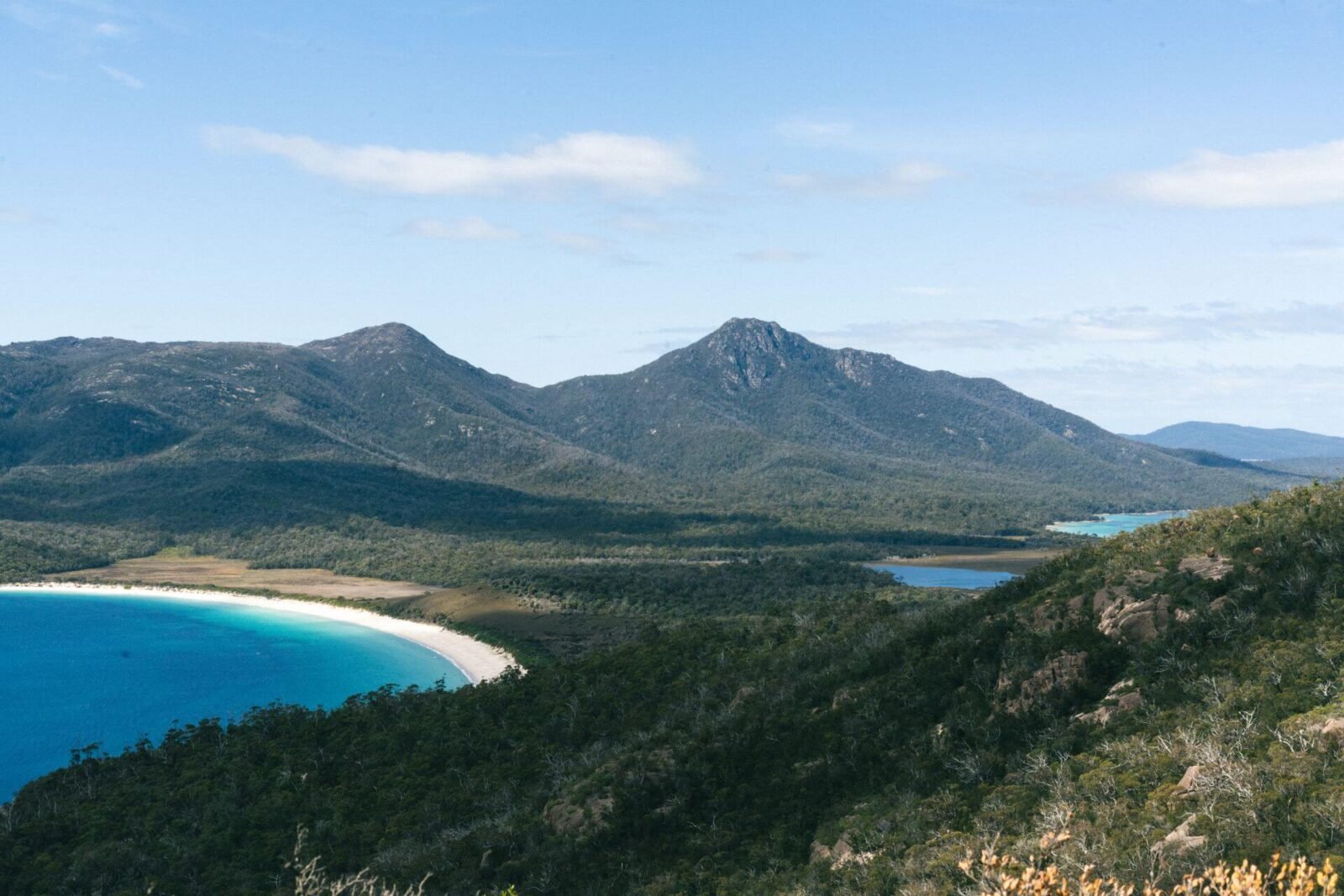
The beach forms a sweeping curve between granite headlands on the eastern side of the peninsula. From the lookout above, the pale sand and water sit below the surrounding slopes, creating the view that appears across countless Tasmania travel photographs.
There are several ways to experience Wineglass Bay, and they should not be confused with one another.
- Wineglass Bay Lookout: the classic elevated view.
- Wineglass Bay Beach: continue down from the saddle to the sand.
- Wineglass Bay and Hazards Beach Circuit: continue across the peninsula for a longer circuit.
- Mount Amos: a much harder Grade 4 mountain route providing a different elevated perspective.
- Water-based experiences: selected cruises and kayaking experiences provide another perspective on the coastline.
The most common planning mistake is assuming that the lookout walk and the beach walk are essentially the same activity.
They are not.
The lookout requires a climb to the saddle and returns by the same route. Reaching the beach involves descending many additional steps and then climbing back out unless you continue around the longer circuit.
Wineglass Bay Lookout Walk
The Wineglass Bay Lookout walk is the most popular short hiking experience in Freycinet National Park.
Current Tasmania Parks and Wildlife Service information lists the walk as:
- Distance: 2.6 kilometres return
- Time: approximately 1 to 1.5 hours return
- Grade: Grade 3
A Grade 3 classification means some bushwalking experience is recommended and the track may include steep sections, rough surfaces and many steps.
The route climbs from the Wineglass Bay walking tracks car park towards the saddle between the Hazards. It is not a flat scenic stroll, and travellers with restricted mobility or relevant health limitations should consider whether the climb is appropriate for them.
How Difficult Is Wineglass Bay Lookout?
For regular walkers with reasonable fitness, the lookout is generally manageable, but the climb can still feel strenuous because of the incline and steps.
Walking times should be treated as guidance rather than a target. Allow additional time if you want frequent rests, are walking with children or expect to spend time at the viewpoint.
When Should You Walk to the Lookout?
There is no single perfect time because weather, cloud and light change constantly.
Earlier starts can help visitors avoid part of the busier daytime period, particularly during popular holiday seasons, while later light can change the appearance of the granite and water.
Safety and weather should remain more important than photography plans.
Is the Lookout Enough?
For many visitors, yes.
You do not need to descend to Wineglass Bay Beach to have a worthwhile Freycinet visit. The lookout provides the classic view and leaves enough time for Cape Tourville, Honeymoon Bay, Sleepy Bay or other parts of the park.
If you have limited time or do not want the additional climb back from the beach, turning around at the lookout is a sensible choice.
Walking to Wineglass Bay Beach
Visitors who want to stand on Wineglass Bay Beach can continue beyond the saddle and descend towards the eastern side of the peninsula.
Current Tasmania Parks and Wildlife Service information lists the Wineglass Bay walk as:
- Distance: approximately 6 kilometres return
- Time: approximately 2.5 to 3.5 hours return
- Grade: Grade 3
The route involves approximately 1,000 stairs on the descent towards the beach according to Parks guidance.
That detail matters because every metre descended needs to be regained if you return by the same route.
What Is Wineglass Bay Beach Like?
From the sand, Wineglass Bay feels very different from the famous elevated photograph.
The surrounding mountains become more dominant, and the scale of the beach becomes much clearer. Walking towards the southern end can provide views back towards the Hazards.
There are limited facilities. Tasmania Parks and Wildlife Service advises that a composting toilet is available at Wineglass Bay, but there are no rubbish bins at the beach. Everything you carry in should be carried back out.
Can You Swim at Wineglass Bay?
People do enter the water at Wineglass Bay, but it is an unpatrolled beach.
Do not interpret clear water or a calm-looking photograph as proof of safe swimming conditions. Water temperature, swell, currents and weather vary, and visitors should assess actual conditions and their own swimming ability before entering the sea.
Wineglass Bay & Hazards Beach Circuit
Instead of climbing directly back from Wineglass Bay, experienced walkers can continue across the peninsula and return via Hazards Beach.
Current Parks information lists the circuit as:
- Distance: approximately 11 kilometres
- Time: approximately 4 to 5 hours
- Grade: Grade 4
The Grade 4 classification is important. This is a more substantial bushwalk than the standard Wineglass Bay Lookout or beach return route.
The circuit allows walkers to experience both sides of the peninsula, moving from Wineglass Bay across the isthmus towards Hazards Beach before following the western coastline back towards the main walking-track area.
Why Choose the Circuit?
The main advantage is variety.
Rather than walking to Wineglass Bay and retracing the entire route, the circuit introduces a second beach and another side of the peninsula.
It also moves visitors beyond the most heavily photographed part of Freycinet and gives a better sense of how the mountains, beaches and western bays connect geographically.
Carry adequate water and food, check the weather, allow sufficient daylight and choose the route according to the least experienced member of your group.
Mount Amos
Mount Amos is one of Freycinet’s most dramatic walks, but it is also one of the places where social-media images can create a misleading impression of difficulty.
The summit provides an elevated view over Wineglass Bay and the surrounding peninsula, but reaching it requires steep scrambling over exposed granite slabs.
Tasmania Parks and Wildlife Service currently classifies Mount Amos as:
- Distance: 3.6 kilometres return
- Time: approximately 3 hours return
- Grade: Grade 4
Parks specifically describes the route as suitable for physically fit and well-equipped walkers and warns that the steep rock slabs become extremely dangerous when wet.
The official guidance is clear: the walk should not be undertaken when it is wet or likely to become wet.
Is Mount Amos a Normal Hiking Track?
No.
Although the distance appears relatively short, distance alone is a poor measure of the difficulty. The route crosses steep bare granite, requires confidence on rock and is exposed to changing weather near the summit.
Robust walking footwear is recommended, and the route is not recommended for young children or visitors for whom steep scrambling is unsuitable.
Mount Amos or Wineglass Bay Lookout?
These walks should not be treated as interchangeable versions of the same viewpoint.
Wineglass Bay Lookout is Grade 3 and follows a constructed track to the saddle. Mount Amos is Grade 4 and involves steep exposed granite scrambling.
Visitors who simply want a beautiful view of Wineglass Bay do not need to climb Mount Amos.
Choose Mount Amos because the challenging mountain walk itself suits your experience and fitness—not merely because you have seen photographs from the summit.
Cape Tourville
Cape Tourville is one of the most useful places to include in a Freycinet itinerary because it provides broad coastal views without requiring a demanding hike.
The current Parks classification is:
- Distance: approximately 600 metres circuit
- Time: approximately 20 minutes
- Grade: Grade 1
The elevated track loops around the automated lighthouse and provides views towards the Hazards, Wineglass Bay and offshore rocks known as The Nuggets.
Sea-eagles, seabirds, dolphins, seals and whales have all been observed from this area, although wildlife sightings can never be guaranteed.
Who Is Cape Tourville Best For?
Cape Tourville is particularly useful for visitors who have limited time, families looking for an easier walk or travellers who cannot undertake the steeper Wineglass Bay tracks.
It also works well as a second activity after Wineglass Bay Lookout because the experience is different rather than repetitive.
Hazardous cliffs remain nearby, so visitors should stay within barriers and supervise children carefully.
Honeymoon Bay
Honeymoon Bay is a small sheltered bay within the main Freycinet visitor area.
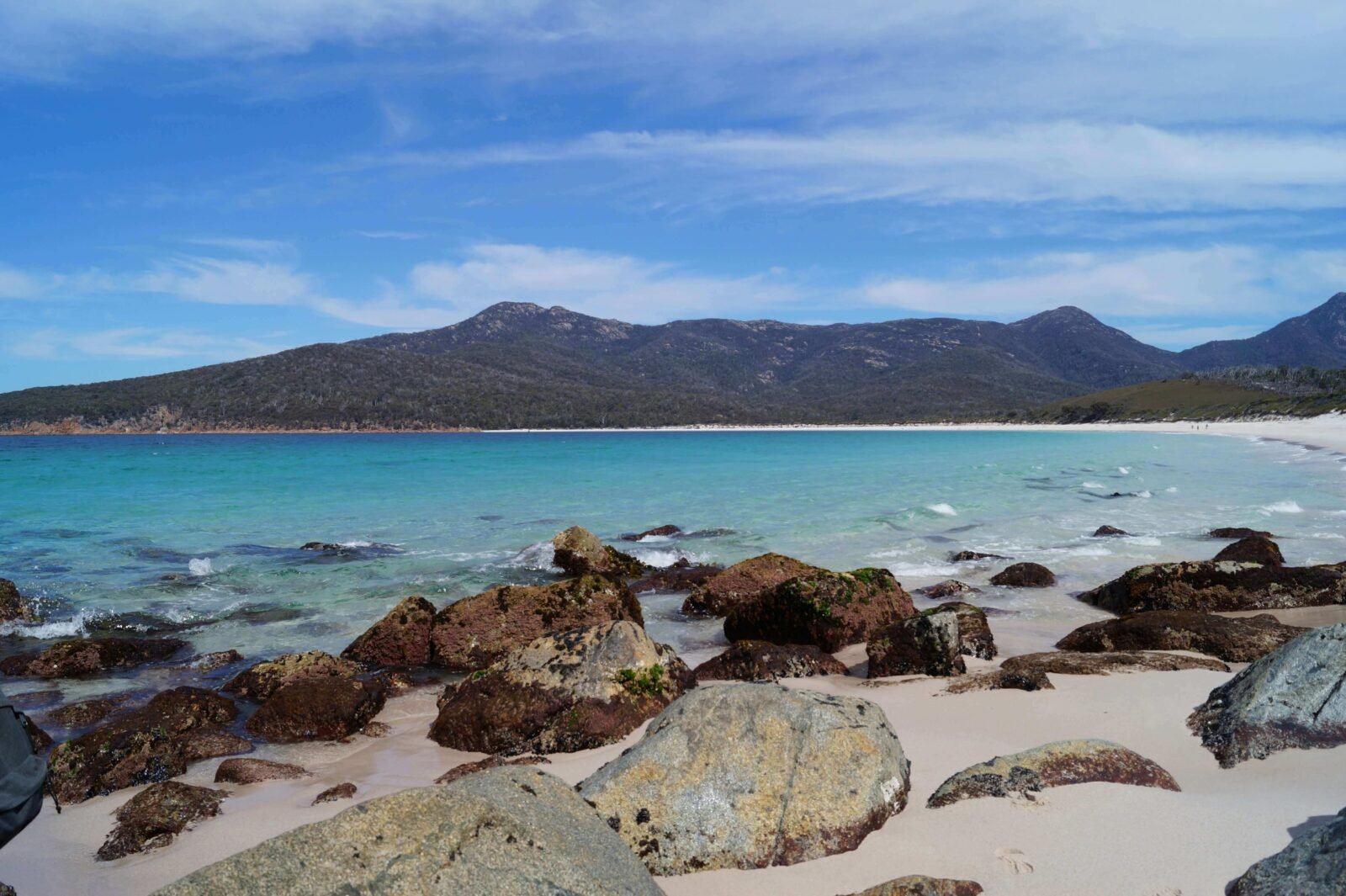
Granite shoreline, clear water and views towards the surrounding mountains make it a useful contrast to the longer open beaches elsewhere in the park.
It is also one of the easiest places to add to a day that already includes a significant walk.
Instead of finishing Wineglass Bay Lookout and immediately driving out of Freycinet, visitors can spend some quieter time around the western shoreline.
Swimming at Honeymoon Bay
The bay’s sheltered appearance can make swimming attractive in suitable weather, but conditions should still be assessed on the day.
Tasmania’s coastal water can be cold, and no natural swimming location should be assumed safe simply because it looks calm from shore.
Electric barbecues, picnic tables and toilets are available in the Honeymoon Bay area according to current Parks information, making it one of the more practical places for a break within the main park.
Sleepy Bay
Despite its gentle name, Sleepy Bay reveals a more rugged side of Freycinet.
The bay sits on the eastern side of the peninsula and is characterised by turquoise water, rocky shoreline and orange-lichen-covered granite.
Tasmania Parks and Wildlife Service currently lists the walk as:
- Distance: approximately 500 metres return
- Time: approximately 20 minutes return
- Grade: Grade 3
The short distance makes Sleepy Bay easy to combine with Cape Tourville, but the Grade 3 classification means visitors should still expect a less even surface than the Cape Tourville boardwalk.
The difference between Sleepy Bay and Honeymoon Bay also demonstrates Freycinet’s coastal diversity. One faces a more exposed eastern coastline while the other sits on the sheltered western side of the peninsula.
Friendly Beaches
Friendly Beaches forms a separate northern section of Freycinet National Park and is easy to overlook if your entire visit is focused on Wineglass Bay.
The landscape here is very different from the enclosed bays around the Hazards.
Long stretches of white sand face the open Tasman Sea, creating a more expansive and exposed coastal environment.
Parks lists walking possibilities ranging from very short access to several hours along the beach, with routes generally classified Grade 2.
Friendly Beaches can suit visitors who want beach walking, photography, fishing, camping or simply more space after spending time around Freycinet’s busier main visitor area.
How Do You Reach Friendly Beaches?
The Friendly Beaches turn-off is reached from Coles Bay Road rather than through the main Freycinet visitor entrance.
Parks advises that the turn-off is via a gravel road. Rental-car users should check their agreement before driving on unsealed roads.
Swimming at Friendly Beaches
Friendly Beaches is exposed to the Tasman Sea and is unpatrolled.
Visitors should assess surf and weather conditions carefully rather than assuming that the pale sand and clear water indicate gentle swimming conditions.
Best Walks in Freycinet National Park
Walking is one of the main reasons people visit Freycinet, but the park’s routes vary enormously in difficulty.
The best walk is therefore not necessarily the one with the most dramatic photograph. It is the route that matches your fitness, experience, available time and the conditions on the day.
Cape Tourville Circuit
600 metres | around 20 minutes | Grade 1
This is the easiest major developed walk covered in this guide and one of the strongest choices for broad coastal scenery with minimal walking difficulty.
Sleepy Bay
500 metres return | around 20 minutes | Grade 3
A short route leading towards a rocky eastern bay. Useful in combination with Cape Tourville.
Wineglass Bay Lookout
2.6 kilometres return | 1–1.5 hours | Grade 3
The classic Freycinet walk. Expect climbing and many steps rather than a flat lookout path.
Wineglass Bay Beach
6 kilometres return | 2.5–3.5 hours | Grade 3
Continue beyond the lookout saddle and descend approximately 1,000 stairs towards the beach before returning by the same route.
Wineglass Bay & Hazards Beach
11 kilometres circuit | 4–5 hours | Grade 4
A more substantial circuit combining both sides of the peninsula.
Mount Amos
3.6 kilometres return | around 3 hours | Grade 4
A steep scrambling route for physically fit, well-equipped and experienced walkers. Do not undertake it when the rock is wet or likely to become wet.
Freycinet Walk and Cycle Track
Parks also maintains a shared walking and cycling track connecting the visitor centre with the walking-track area.
The current listing describes it as approximately 4 kilometres one way, around one hour on foot and Grade 2.
Sections are wheelchair friendly rather than the entire route, so visitors with accessibility requirements should check current local advice before relying on the whole track.
Freycinet Peninsula Circuit
For walkers who want to experience Freycinet beyond its day walks, the Freycinet Peninsula Circuit provides a multi-day journey through beaches, forest, coastal heath, granite country and mountain landscapes.
Tasmania Parks and Wildlife Service currently lists the circuit as approximately:
- Distance: 27 kilometres
- Time: 2–3 days
- Grade: Grade 3
Parks recommends walking the circuit anti-clockwise from the Wineglass Bay car park, beginning down the western side of the peninsula.
A multi-day route should not be planned as simply a longer version of the Wineglass Bay day walk.
Overnight walkers need to consider water, food, weather, navigation, camping arrangements, emergency preparation and the conditions expected across the full journey rather than just at the trailhead.
Who Is the Peninsula Circuit For?
The circuit can suit walkers with suitable bushwalking experience who are prepared for self-supported overnight travel.
Travellers who are new to overnight walking should not assume that a Grade 3 classification removes the need for careful preparation. Carrying overnight equipment changes the physical demands compared with a day walk.
Check the latest official walk notes, campsite information, water guidance and weather before departing.
Beaches in Freycinet National Park
Freycinet’s beaches are not all variations of Wineglass Bay.
The peninsula’s geography creates sheltered western bays, exposed eastern coastline and long beaches farther north.
Wineglass Bay
The most famous beach requires a significant walk to reach on foot and is best considered part of a hiking day rather than a convenient roadside swimming stop.
Hazards Beach
Hazards Beach lies on the western side of the peninsula and forms part of the Wineglass Bay–Hazards Beach circuit.
Its position provides a very different outlook from Wineglass Bay and helps make the longer circuit more varied.
Honeymoon Bay
Honeymoon Bay is small, accessible and comparatively sheltered, making it easy to combine with other attractions.
Friendly Beaches
Friendly Beaches provides the opposite experience: long, open stretches of sand facing the Tasman Sea.
Richardsons Beach
Richardsons Beach lies close to the main visitor area and is associated with some of Freycinet’s established camping facilities.
It can be useful for travellers who want a beach experience without committing to the walk into Wineglass Bay.
Regardless of which beach you choose, remember that Freycinet’s beaches are unpatrolled. Conditions should always be assessed locally.
Wildlife in Freycinet National Park
Freycinet protects coastal, woodland, heath and marine environments that support a variety of wildlife.
Visitors may encounter wallabies, pademelons, possums and numerous bird species, while dolphins, seals and whales may sometimes be observed offshore.
Wildlife encounters should be treated as opportunities to observe natural behaviour rather than opportunities to create close photographs.
Do Not Feed Wildlife
Feeding wildlife can alter natural behaviour and encourage animals to associate people with food.
Parks specifically warns that possums may investigate unattended food and bags. Keep food secured and do not deliberately attract animals.
Wildlife on the Road
Animals are also an important driving consideration.
Tasmania Parks and Wildlife Service asks visitors to avoid driving in reserves at night where possible because native wildlife shares the roads.
If you do need to drive around dawn, dusk or after dark, reduce speed and remain alert.
Whales & Dolphins
Dolphins and migrating whales can sometimes be seen around Freycinet’s coastline.
Cape Tourville provides an elevated ocean viewpoint, while visitors at Wineglass Bay may also be fortunate enough to see marine mammals during migration periods.
Sightings are unpredictable, so wildlife should be considered an added experience rather than something guaranteed by an itinerary.
Kayaking, Boating & Water Activities
Freycinet’s geography makes water-based exploration an appealing alternative to seeing the peninsula entirely from walking tracks.
Kayaking can provide a lower perspective beneath the Hazards and access to parts of the shoreline that look very different from land.
Boat and cruise experiences can also provide another way of seeing Wineglass Bay and the wider coastline.
Sea Kayaking
Guided sea kayaking can suit travellers who want to experience the sheltered side of Freycinet from the water without planning an independent marine journey.
Conditions remain important. Wind and sea state can alter plans, and operators may adjust routes according to safety considerations.
Cruises
Boat trips around Freycinet can provide access to coastal views that are difficult or impossible to see from roads.
If a cruise is a major priority, check current operating days, departure locations and weather policies before fixing the rest of the day’s schedule.
Independent Water Activities
Experienced visitors with their own equipment should make decisions according to actual marine conditions, ability and local restrictions rather than the appearance of sheltered water from shore.
Tasmanian coastal conditions can change quickly, and cold water increases the consequences of an unexpected capsize or prolonged immersion.
Photography in Freycinet National Park
Freycinet is highly photogenic because the landscape changes substantially over short distances.
The Hazards can appear warm and pink in some light and muted grey under cloud. Great Oyster Bay can be glassy or wind-affected. The eastern coastline can look completely different from the protected bays on the western side.
Wineglass Bay Lookout
The lookout provides the classic elevated photograph of Wineglass Bay.
Cloud, haze and the angle of the sun affect water colour dramatically, so visitors should not expect the bay to look identical to heavily edited photographs seen online.
Cape Tourville
Cape Tourville is particularly useful for wider coastal compositions, distant views and changing ocean conditions.
Honeymoon Bay
The smaller scale of Honeymoon Bay provides opportunities to frame granite, water and the Hazards within a more intimate coastal scene.
Friendly Beaches
Long sand, open sky and the Tasman Sea make Friendly Beaches particularly suited to wider landscape photography.
Photography Should Not Override Safety
Do not cross barriers, climb unstable cliffs, stand in dangerous surf or attempt Mount Amos in unsafe conditions for a photograph.
Drones are not permitted within Tasmanian national parks and reserves under current Parks guidance.
Do You Need a Parks Pass for Freycinet National Park?
Yes. A valid parks pass is required for entry to Tasmania’s national parks, including Freycinet National Park.
Tasmania Parks and Wildlife Service offers different pass types, and the most appropriate option depends on how many national parks you intend to visit and how long you are travelling.
If Freycinet is your only national park visit, one option may make sense. If your itinerary also includes places such as Cradle Mountain, Mount Field, Tasman National Park, South Bruny or other national parks, compare the available multi-park options.
Prices and pass conditions can change, so this page intentionally does not hard-code a price that may later become outdated.
Check the current Tasmania Parks and Wildlife Service information immediately before your trip.
Freycinet Visitor Centre & Facilities
The Freycinet Visitor Centre is located inside the main entrance to the park and is useful for current information about walks, conditions and park facilities.
At the time of this fact-check, Tasmania Parks and Wildlife Service lists the visitor centre as open daily from 9 am to 4 pm. Opening arrangements can change, so confirm current hours before relying on them.
Drinking Water
Water deserves particular attention at Freycinet.
Parks advises that drinking water is scarce within the national park. A filtered and chilled refill station is available at the visitor centre, with taps also currently listed at Honeymoon Bay and the Wineglass Bay walking tracks car park.
Do not begin a substantial walk assuming you will find drinking water along the route.
Toilets
Toilets are available at several developed visitor areas, including the walking tracks car park. A composting toilet is available at Wineglass Bay according to current Parks information.
Facilities are not available continuously along walking tracks, so plan accordingly.
Picnic & Barbecue Facilities
Electric barbecues, picnic tables and toilets are currently listed at Honeymoon Bay and Ranger Creek.
Always check current fire and fuel-stove restrictions, particularly during warmer and drier periods.
Camping in Freycinet National Park
Camping can be one of the best ways to spend more time in Freycinet, but different camping areas operate under different arrangements.
Do not assume that all sites use the same booking system, fees or facilities.
Richardsons Beach, Honeymoon Bay & Ranger Creek
These established camping areas sit around the main Freycinet visitor zone and provide convenient access to the park.
Demand can be particularly high during popular summer and holiday periods, and special allocation arrangements may apply during peak times.
Check current Parks information well before travelling rather than assuming you can arrive and obtain a site.
Friendly Beaches Camping
Camping is also available at Isaacs Point in the Friendly Beaches section.
At the time of this fact-check, Tasmania Parks and Wildlife Service lists Friendly Beaches camping as having no camping charge and no booking requirement. A valid national parks pass is still required for entry to the national park.
These arrangements can change, so verify them before relying on this information for an overnight stay.
The area is currently designated Fuel Stove Only, meaning fires are prohibited.
Overnight Walker Camping
Walkers undertaking the Freycinet Peninsula Circuit use separate overnight walking campsites.
These should be planned according to the official circuit notes rather than treated like vehicle-access campgrounds.
If you are touring Tasmania by campervan or tent, an Australian camping and road-trip guide may help with researching stops elsewhere on your trip. Always confirm individual campground rules with the relevant land manager before staying.
Where to Stay Near Freycinet National Park
Where you stay has a surprisingly large impact on the quality of a Freycinet visit.
A long drive before and after a major walk can turn an enjoyable day into a tiring one, while staying nearby allows more flexibility around weather.
Coles Bay
Coles Bay is the most convenient base for the main national park.
Choose it when Wineglass Bay, Mount Amos, Cape Tourville and the main peninsula are your priorities.
Freycinet Area
Accommodation is also distributed around the wider Coles Bay and Freycinet area, ranging from simple holiday accommodation to higher-end stays.
Compare location as carefully as price. A property described broadly as being in the Freycinet region may not necessarily sit beside the walking-track car park.
Swansea
Swansea can work for visitors approaching from the south and provides views across Great Oyster Bay towards the Freycinet Peninsula.
It is less convenient for an early start at the walking tracks but can be attractive for travellers who want to divide their East Coast journey more evenly.
Bicheno
Bicheno is a useful alternative north of Freycinet and has enough attractions to justify being a destination itself.
It can work particularly well after spending one or two nights around Coles Bay, allowing the road trip to continue naturally towards St Helens and the Bay of Fires.
When your dates are fixed, you can compare accommodation near Freycinet National Park across Coles Bay and the wider East Coast.
Best Time to Visit Freycinet National Park
Freycinet can be visited throughout the year, but each season changes the experience.
Summer: December to February
Summer provides long daylight hours and generally warmer conditions, making it popular for walking, beaches, camping and water activities.
It is also a busy period. Accommodation and camping demand can be high, and popular tracks may have more visitors.
Do not assume every summer day will be hot or calm. Coastal weather remains variable.
Autumn: March to May
Autumn can provide comfortable conditions for walking while some of the peak summer demand begins to ease.
Daylight shortens as the season progresses, so longer walks need increasingly careful timing.
Winter: June to August
Winter can reveal a quieter, moodier version of Freycinet.
Cooler temperatures may suit some walkers, but shorter daylight, wet rock and changing weather need greater attention.
Mount Amos in particular should not be attempted when wet or when rain is likely.
Spring: September to November
Spring brings increasing daylight and flowering vegetation but can remain highly changeable.
Carry layers and waterproof protection even when the forecast initially appears favourable.
So What Is the Best Month?
There is no universally best month.
Visitors prioritising swimming and long daylight may prefer summer. Walkers who value cooler conditions and somewhat lower visitor numbers may prefer autumn or spring. Travellers who value quiet landscapes may enjoy winter.
The better approach is to choose the season according to your preferred activities and prepare for Tasmanian weather rather than trying to identify one perfect date.
How Long Should You Spend in Freycinet National Park?
Freycinet can be visited in a day, but the amount of time you should spend depends heavily on whether you want a photograph of Wineglass Bay or a broader experience of the peninsula.
Half a Day
A half-day works only for a focused visit.
Choose one principal activity—most commonly Wineglass Bay Lookout—and perhaps one short nearby stop such as Honeymoon Bay.
Trying to include Wineglass Bay, Cape Tourville, Friendly Beaches and Coles Bay in a few hours will usually turn the visit into constant movement.
One Full Day
One full day is enough for a strong introduction.
You could walk to Wineglass Bay Lookout in the morning, visit Honeymoon Bay, explore Cape Tourville and spend time around Coles Bay.
Alternatively, dedicate most of the day to the longer Wineglass Bay and Hazards Beach circuit.
Two Days
Two days is an excellent amount of time for many first-time visitors.
It creates flexibility around weather and allows one substantial walking day plus a second day for beaches, Cape Tourville, kayaking or Friendly Beaches.
Three Days
Three days suits travellers who want to slow down.
You can complete more than one walk, explore the different sides of the peninsula and still leave time for a quiet beach or water-based activity.
More Than Three Days
Longer stays make sense for serious walkers, campers, photographers, kayakers or visitors planning the Freycinet Peninsula Circuit.
Freycinet does not need to be filled with scheduled attractions every day. Part of the value of staying longer is having enough flexibility to change plans when weather changes.
Suggested Freycinet National Park Itineraries
These itineraries are planning frameworks rather than fixed schedules. Walking conditions, weather and individual fitness should determine what you actually do on the day.
One-Day Freycinet Itinerary
- Morning: Begin with Wineglass Bay Lookout while you have plenty of time and energy.
- Late morning: Return to the main visitor area and take a break around Honeymoon Bay.
- Afternoon: Drive towards Cape Tourville and complete the short circuit.
- Later afternoon: Add Sleepy Bay if time, conditions and energy allow.
- Evening: Return to Coles Bay rather than scheduling another major drive if you are staying locally.
If you intend to walk all the way to Wineglass Bay Beach, reduce the number of additional stops rather than rushing the longer walk.
Two-Day Freycinet Itinerary
Day 1 – Wineglass Bay and the Hazards
- Visit the Freycinet Visitor Centre if you need current information.
- Walk to Wineglass Bay Lookout.
- Continue to Wineglass Bay Beach if appropriate for your group.
- Spend the later part of the day around Honeymoon Bay or Coles Bay.
Day 2 – The Wider National Park
- Walk the Cape Tourville circuit.
- Visit Sleepy Bay.
- Explore Friendly Beaches.
- Allow time for a relaxed lunch, beach stop or water-based experience.
This itinerary provides considerably more variety than spending both days repeatedly around Wineglass Bay.
Three-Day Freycinet Itinerary
Day 1 – Wineglass Bay
Choose between Wineglass Bay Lookout, the beach return walk or the longer Hazards Beach circuit according to fitness and conditions.
Day 2 – Coast & Water
Explore Cape Tourville, Sleepy Bay and Honeymoon Bay, or use part of the day for kayaking or a cruise.
Day 3 – Friendly Beaches & the Wider East Coast
Spend time around Friendly Beaches before continuing north towards Bicheno or south towards Swansea.
For the next stage of your journey, return to the East Coast Tasmania Travel Guide.
Freycinet in a 7-Day Tasmania Trip
If you only have a week in Tasmania, Freycinet usually works best as one of a small number of major destinations rather than being combined with every region.
For example:
Hobart → Port Arthur or Bruny Island → Freycinet → Bicheno → Launceston.
Alternatively:
Hobart → Freycinet → Bay of Fires → Launceston.
Trying to combine Freycinet with Hobart, Port Arthur, Bruny Island, Bay of Fires, Cradle Mountain, the West Coast and the north-west within seven days usually creates more driving than meaningful time in each destination.
Our complete Tasmania trip planning guide can help you decide which regions to prioritise.
Walking & Visitor Safety in Freycinet
Freycinet’s popularity should not create the impression that every walk is easy or risk-free.
Tasmania Parks and Wildlife Service warns that tracks can involve steep granite and loose gravel surfaces, while the park also contains hazardous cliffs and unpatrolled beaches.
Choose the Walk for Your Group
Choose according to the least experienced or least fit member of the group rather than the strongest walker.
A route being popular does not mean it is appropriate for everyone.
Check the Weather
Conditions can change at any time of year.
Check the forecast before setting out and be prepared to turn around if conditions deteriorate.
This is particularly important on exposed granite routes such as Mount Amos.
Wear Suitable Footwear
Sturdy footwear is recommended for Freycinet’s steeper and rougher tracks.
Smooth granite can become extremely slippery when wet.
Carry Water
Drinking water is scarce inside the park.
Fill bottles before beginning your walk and carry enough for the conditions and route length.
Tell Someone Your Plans
For longer walks, let someone know your intended route and expected return time.
Parks also recommends recording trip intentions where log books are provided.
Consider a PLB for Remote Walking
For remote walks or uncertain conditions, Parks recommends considering a Personal Locator Beacon along with additional emergency preparation.
Supervise Children
Hazardous cliffs, unpatrolled beaches, steep tracks and granite surfaces mean children require close supervision in many parts of the park.
Do Not Treat Walking Times as Deadlines
Official walking times are useful planning estimates, not targets.
Allow more time if your group walks slowly, conditions are hot, the track is crowded or you want to spend time enjoying the destination.
Responsible Travel in Freycinet National Park
Freycinet receives large numbers of visitors because its landscapes are exceptional. That popularity also makes responsible visitor behaviour particularly important.
Take Your Rubbish With You
Bins are not provided along many walking routes or at remote beaches.
Carry everything you bring into the park back out with you.
Stay on Tracks
Using established tracks helps reduce damage to vegetation and erosion.
A shortcut created for a photograph can gradually become a much larger area of damaged ground when repeated by thousands of visitors.
Respect Wildlife
Do not feed native animals or leave food unattended.
Observe wildlife quietly and give animals enough space to move away.
Respect Fire Restrictions
Fuel-stove-only rules and fire restrictions apply in parts of the park and may change according to conditions.
Check current requirements rather than relying on previous visits or old information online.
Leave Natural Objects Where They Are
Shells, rocks, plants and other natural materials form part of the protected environment.
Photograph them rather than taking them home.
Drones
Tasmania Parks and Wildlife Service currently states that drones are not permitted to be used within Tasmanian national parks and reserves.
Visitors should follow current official rules rather than assuming recreational drone use is permitted because they have seen aerial footage online.
Practical Tips for Visiting Freycinet National Park
1. Stay Nearby If Freycinet Is a Priority
Staying around Coles Bay makes an early start easier and gives you flexibility when weather changes.
2. Do Not Build the Entire Visit Around One Photograph
Wineglass Bay is important, but Cape Tourville, Friendly Beaches, Honeymoon Bay and Sleepy Bay reveal other sides of the park.
3. Match the Walk to Your Ability
Wineglass Bay Lookout and Mount Amos are not interchangeable routes.
Choose according to actual experience and conditions rather than the view you want to post online.
4. Carry Water
Water is scarce inside the national park. Refill before walking and carry enough for your planned route.
5. Bring Layers
Tasmanian coastal weather can change quickly.
Even when the day begins warm and calm, carry clothing suitable for wind or cooler conditions if you are undertaking a substantial walk.
6. Download Maps Before You Need Them
Do not rely entirely on continuous mobile coverage.
Download relevant maps and save booking information before travelling.
International visitors who want mobile data can check eSIM options for Australia before travelling. An eSIM cannot eliminate network black spots, so offline information remains useful.
7. Avoid Unnecessary Night Driving
Native wildlife can move onto roads, particularly around dawn, dusk and at night.
Where possible, arrange accommodation and activities so that a full walking day does not finish with a long rural drive after dark.
8. Leave Space in the Itinerary
Weather may make one activity unsuitable while another remains enjoyable.
A flexible two-day visit is often more rewarding than a tightly scheduled single day containing every major attraction.
9. Check Conditions on the Day
Before undertaking a substantial walk, check weather, current alerts, fire information and track conditions.
Information saved months before your holiday should not replace current official advice.
10. Plan Freycinet as Part of the East Coast
Unless Freycinet is your only Tasmania destination, avoid thinking of the park in isolation.
Swansea, Bicheno, St Helens and the Bay of Fires can connect naturally into the same road trip.
Use our East Coast Tasmania guide for the broader route and our Travel Tasmania pillar guide when connecting the East Coast with other regions.
Frequently Asked Questions About Freycinet National Park
Is Freycinet National Park worth visiting?
For travellers interested in Tasmania’s coastal landscapes, beaches and walking, Freycinet is one of the strongest destinations on the East Coast. Wineglass Bay is the best-known attraction, but the park also contains Cape Tourville, Mount Amos, Honeymoon Bay, Sleepy Bay, Friendly Beaches and longer peninsula walks.
How many days do you need in Freycinet National Park?
One full day provides a useful introduction, while two days is a better choice for many first-time visitors. Three days allows greater flexibility for longer walks, beaches and water-based activities. Multi-day walkers need additional time.
Can you visit Freycinet in one day?
Yes. A one-day visit can include Wineglass Bay Lookout and several shorter attractions such as Honeymoon Bay or Cape Tourville. Avoid trying to complete every major attraction in the same day.
Can you visit Freycinet as a day trip from Hobart?
Yes, but it creates a long day once return driving and walking are combined. Tasmania Parks and Wildlife Service estimates the park at roughly 2.5 to 3 hours from Hobart. Staying on the East Coast is generally more relaxed if your itinerary allows it.
Can you visit Freycinet from Launceston?
Yes. Parks gives a broad travel estimate of roughly 2.5 to 3 hours from Launceston. Freycinet can work particularly well within a longer Launceston–East Coast–Hobart itinerary.
Do you need a parks pass for Freycinet National Park?
Yes. A valid Tasmania parks pass is required for entry to Freycinet National Park. Check current pass types, conditions and prices with Tasmania Parks and Wildlife Service before travelling.
How long is the Wineglass Bay Lookout walk?
Current Parks information lists Wineglass Bay Lookout at approximately 2.6 kilometres return, taking around 1 to 1.5 hours. It is a Grade 3 walk.
How long is the Wineglass Bay Beach walk?
The Wineglass Bay return walk is currently listed at approximately 6 kilometres and 2.5 to 3.5 hours, Grade 3. The route continues beyond the lookout and involves a substantial descent to the beach followed by a climb back out.
How long is the Hazards Beach circuit?
The Wineglass Bay and Hazards Beach circuit is currently listed at approximately 11 kilometres and 4 to 5 hours. It is Grade 4.
How difficult is Mount Amos?
Mount Amos is a challenging Grade 4 walk involving very steep granite slabs and scrambling. Parks lists it at approximately 3.6 kilometres return and around three hours. It is intended for physically fit and properly equipped walkers and should not be attempted when wet or likely to become wet.
Is Mount Amos harder than Wineglass Bay Lookout?
Yes. Wineglass Bay Lookout is Grade 3 and follows a developed track involving climbing and steps. Mount Amos is Grade 4 and involves steep scrambling over exposed granite.
Can beginners climb Mount Amos?
Mount Amos should not be treated as a beginner sightseeing walk. Tasmania Parks and Wildlife Service describes it as a challenging route for physically fit and well-equipped walkers and warns about very steep, slippery rock slabs.
Can you swim at Wineglass Bay?
Visitors do enter the water, but Wineglass Bay is unpatrolled. Conditions, water temperature and swimming ability should be considered carefully before entering the sea.
Is Cape Tourville suitable for families?
Cape Tourville is one of the easiest major walks in Freycinet. Parks lists the circuit at approximately 600 metres, around 20 minutes and Grade 1. Hazardous cliffs remain nearby, so children require supervision and visitors should stay behind barriers.
Is Freycinet suitable for children?
Yes, provided activities are chosen according to age, ability and conditions. Cape Tourville and shorter coastal stops may suit many families, while Mount Amos is specifically not recommended for young children. Children should be closely supervised around cliffs, beaches and steep tracks.
Can you camp in Freycinet National Park?
Yes. Camping is available in several parts of Freycinet, including established areas near the main park and at Friendly Beaches. Different sites have different booking and facility arrangements, so check current Parks information before travelling.
Is Friendly Beaches part of Freycinet National Park?
Yes. Friendly Beaches forms a separate northern section of Freycinet National Park and is accessed separately from the main Coles Bay visitor area.
Do you need a 4WD for Freycinet?
No. The main access through Coles Bay to the Freycinet Visitor Centre is sealed. Some secondary access roads, including the route towards Friendly Beaches, include gravel sections. Rental vehicle restrictions should be checked before using unsealed roads.
Is there drinking water in Freycinet National Park?
Drinking water is limited. Parks currently provides a refill station at the visitor centre and lists taps at Honeymoon Bay and the Wineglass Bay walking tracks car park. Carry sufficient water when walking rather than relying on finding water along the track.
Are there toilets at Wineglass Bay?
A composting toilet is currently available at Wineglass Bay according to Tasmania Parks and Wildlife Service. Toilets are also available at the walking tracks car park and selected developed areas.
Are drones allowed in Freycinet National Park?
No. Tasmania Parks and Wildlife Service currently states that drones are not permitted within Tasmanian national parks and reserves.
Can you see wildlife at Freycinet?
Yes. Native mammals and birds occur throughout the park, while dolphins, seals and migrating whales may sometimes be seen offshore. Sightings are never guaranteed. Do not feed wildlife or approach animals closely.
What is the easiest walk in Freycinet National Park?
Among the major scenic walks covered here, Cape Tourville is one of the easiest. Parks classifies the 600-metre circuit as Grade 1 and estimates around 20 minutes.
What is the best walk in Freycinet?
There is no single best walk for every visitor. Wineglass Bay Lookout is the classic first-time choice, Cape Tourville is excellent for an easier experience, the Hazards Beach circuit provides a longer day walk, and Mount Amos suits appropriately experienced walkers in dry conditions.
Should I stay in Coles Bay or visit Freycinet on a day trip?
Staying in Coles Bay is generally preferable if Freycinet is one of your main Tasmania priorities. It reduces driving and gives you greater flexibility around weather. A day trip remains possible for travellers with limited time.
Is Freycinet better than the Bay of Fires?
They provide different experiences. Freycinet combines mountains, developed walking tracks and enclosed bays, while the Bay of Fires is better understood as a long stretch of north-east coastline known for beaches and orange-lichen-covered granite. If time allows, the two destinations complement each other well within an East Coast road trip.
Can I combine Freycinet and Bay of Fires?
Yes. Freycinet, Bicheno, St Helens and the Bay of Fires form a logical south-to-north East Coast itinerary. Avoid trying to experience both Freycinet and the entire Bay of Fires properly in one rushed day.
What should I bring to Freycinet National Park?
For ordinary day visits, bring suitable footwear, water, sun protection, weather-appropriate layers, food where needed and offline access to important information. Longer or remote walks require additional safety and emergency preparation.
Planning Your Freycinet National Park Visit
Freycinet National Park is famous because of Wineglass Bay, but its value as a destination extends well beyond one viewpoint.
The Hazards give the peninsula its unmistakable mountain backdrop. Wineglass Bay provides the classic elevated view and a rewarding beach walk. Mount Amos offers a much more demanding challenge for suitable walkers. Cape Tourville makes dramatic coastal scenery accessible without a long hike. Sleepy Bay reveals a rugged eastern cove, while Honeymoon Bay provides a quieter western setting. Friendly Beaches opens the landscape into kilometres of exposed coastline farther north.
Trying to see all of these places in a few hours is possible only in the sense that you can drive quickly between some of them.
It is not necessarily the best way to experience Freycinet.
If your Tasmania itinerary allows it, one or two nights around Coles Bay can transform the visit. Instead of worrying about reaching the next town, you can choose a walk according to the weather, spend longer beside the coast and see parts of the park beyond the Wineglass Bay car park.
Once your travel dates are known, you can compare accommodation around Freycinet and Tasmania’s East Coast. If Freycinet is one stage of a larger journey, use our East Coast Tasmania Travel Guide to continue towards Bicheno, St Helens and the Bay of Fires.
Travelling beyond the East Coast? Return to our Travel Tasmania guide for the island-wide regional overview, or use our complete Tasmania trip planning guide to decide how Freycinet fits into a 7-day, 10-day, two-week or longer holiday.
Planning note: Information about national park access, passes, tracks, campsites, visitor facilities, road conditions, fire restrictions and weather can change. Before travelling, particularly before undertaking Mount Amos, the Freycinet Peninsula Circuit or another substantial walk, check current information from Tasmania Parks and Wildlife Service and relevant weather and emergency authorities.
Affiliate disclosure: Some links on this page are affiliate links. If you make a booking or purchase through one of these links, Island Files Tasmania may earn a commission at no additional cost to you. We include affiliate links where they may be useful for planning your trip.